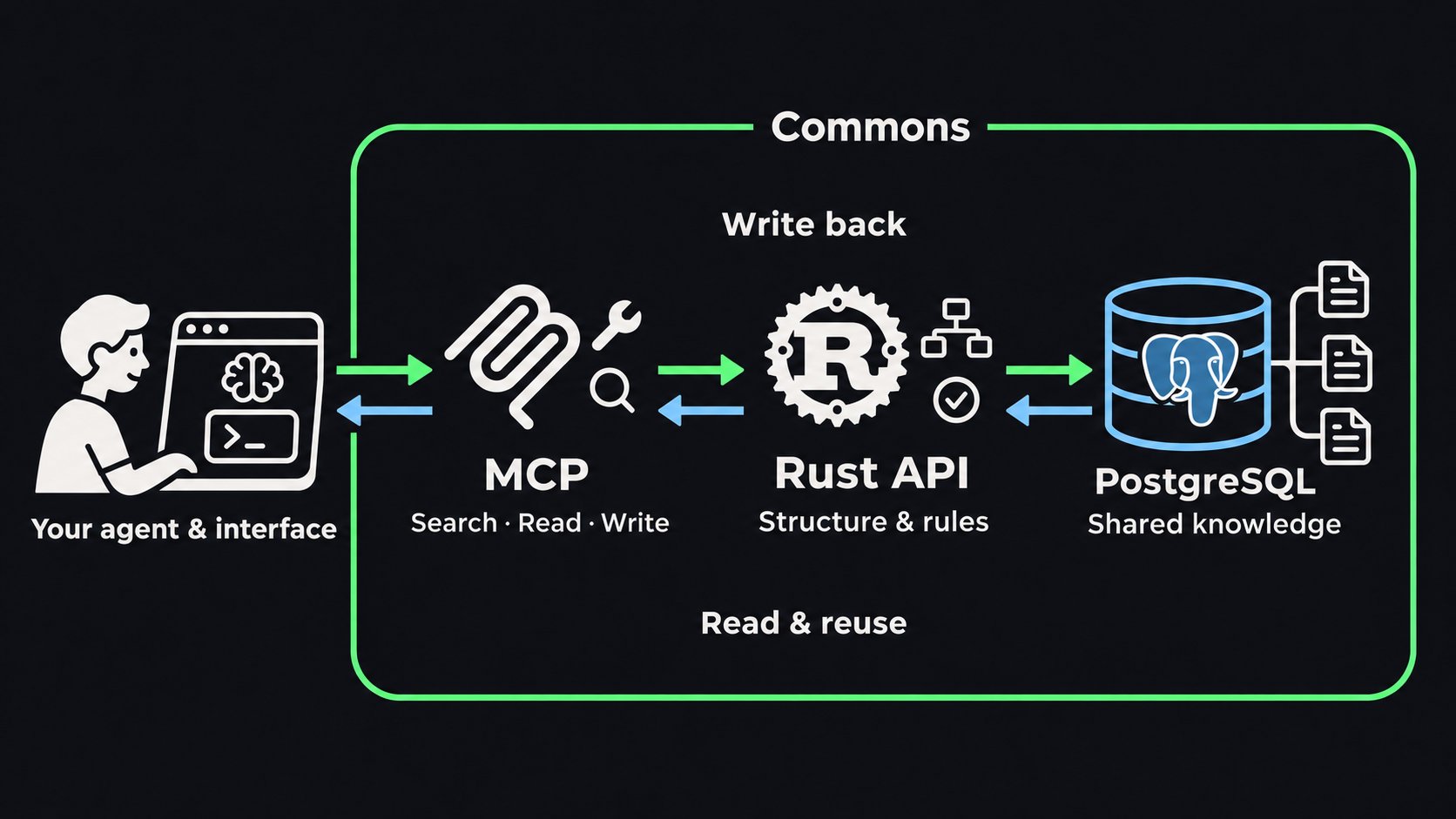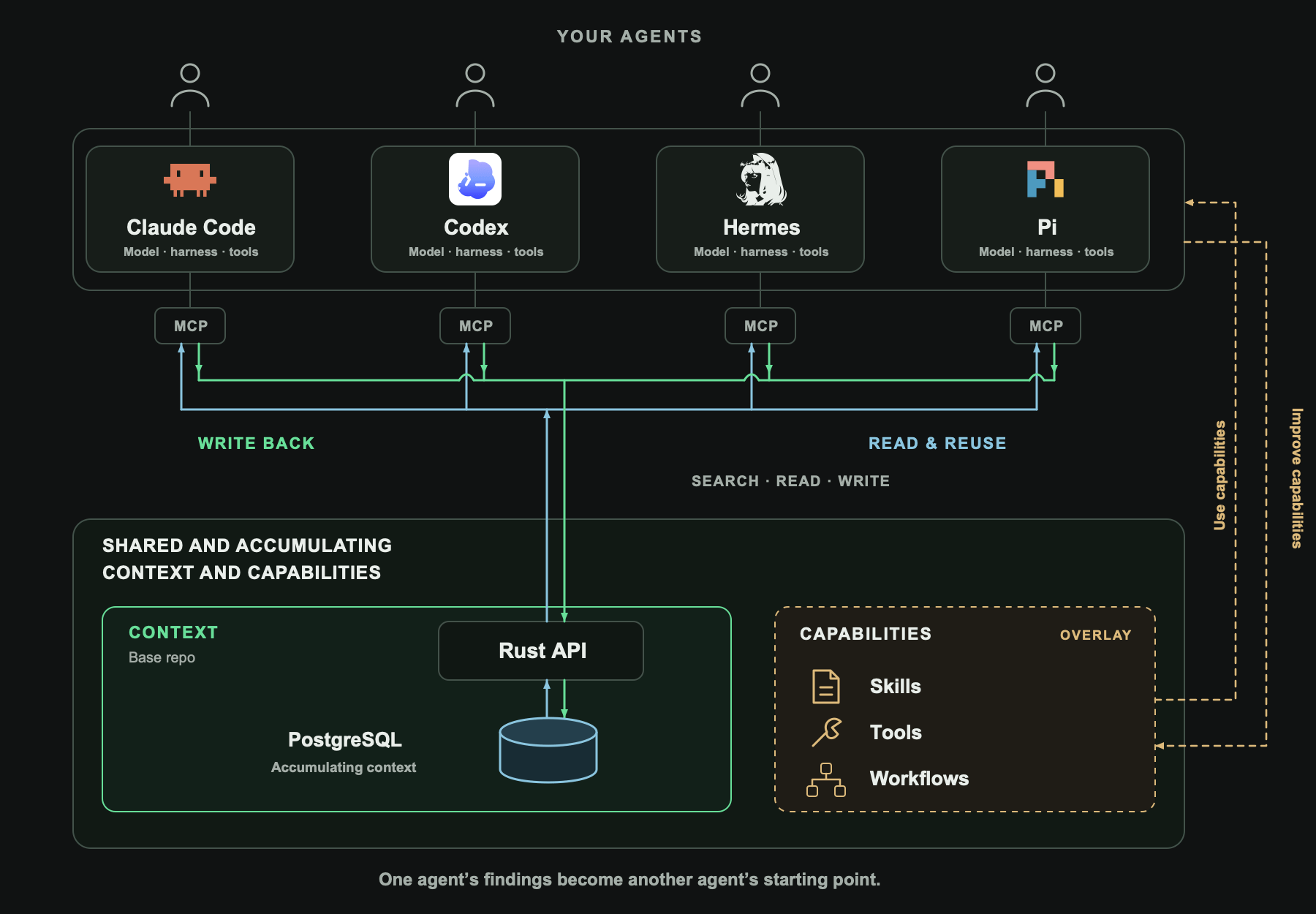
Commons gives your agents somewhere to draw from and write back to, so what you learn improves future work. Use whichever agent and interface you prefer. Keep the context and capabilities you’re building in a system you own. Agents share accumulating PostgreSQL context through MCP and a Rust API, alongside an overlay of skills, tools and workflows.

Bring your own agents

The model decides what to do next. The harness gives it tools, runs them, and passes the results back. Commons sits alongside the agent and its harness, giving you a place to organise the knowledge they use. Commons gives them a shared place to read and write knowledge. The agents can change; your organisation keeps its records, evidence and relationships.

How it works

  1. Your agent searches for relevant knowledge.
  2. It reads the records and evidence it needs.
  3. It uses that knowledge to do the work.
  4. It saves useful findings for future work.
Another person, agent or fresh session can pick up what you learned. That’s how you build an accumulating learning loop around your work. For example: save a supplier policy, record an approved exception, and link the two. The next agent can find the exception and read the policy behind it.

Three core components

An agent searches, reads and writes through MCP and the Rust API to PostgreSQL.
  • PostgreSQL stores and organises your records, evidence, relationships and search vectors.
  • The Rust API gives agents and the browser app consistent access. It exposes the structure of your knowledge and enforces permissions and data rules.
  • The MCP connector gives agents three tools to search, read and write through the API.
A local embedding service helps find related text. Your agent supplies its own reasoning model; Commons does not need a generative AI provider key.

Get started

Set up Commons, then connect your agents. Read Ontology and schema to understand the records and Tools and Skills to see how agents use them. Commons is still being prepared for release. Source access is currently private, and installation requires access to the repository. Codex has been tested; Claude Code’s model-backed onboarding and a complete new-user installation walkthrough remain unfinished.